

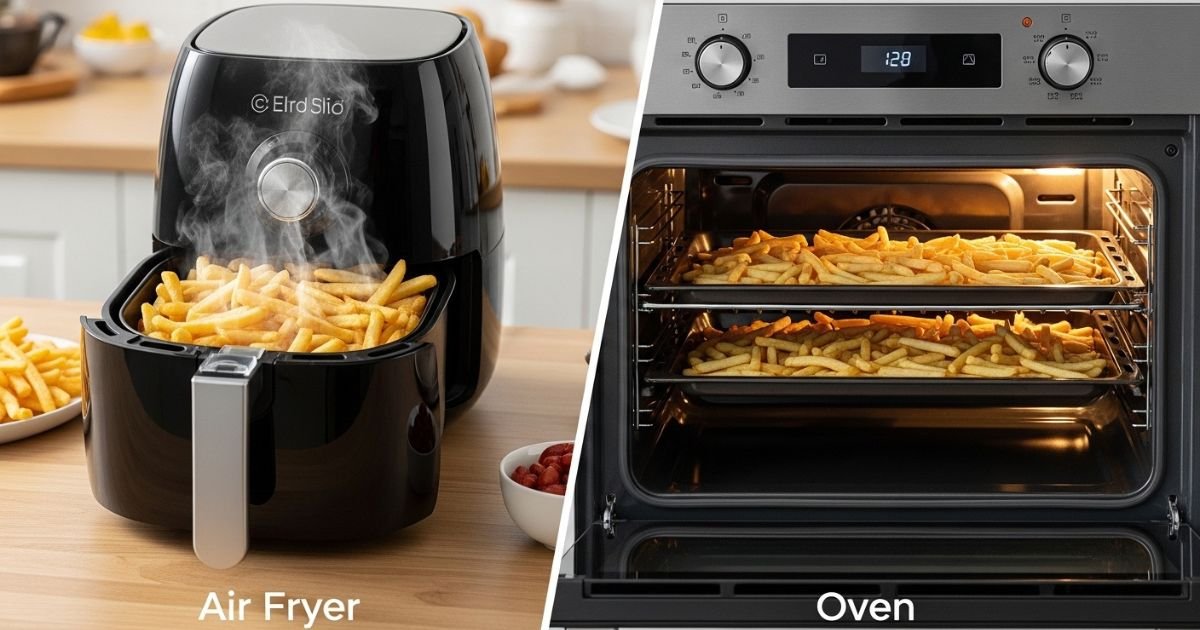
Deciding between an air fryer and an oven comes down to what you cook and how you value time, space, and crispness. You’ll find air fryers heat fast and crisp small batches with less oil, while ovens handle larger meals and a wider range of dishes more easily.
If you want quick, crispy results for snacks and small portions, pick an air fryer; if you need to cook for a family or bake a wide variety of dishes, stick with an oven.
This post will help you match each appliance to your cooking habits, energy goals, and kitchen space so you can choose with confidence. Expect clear comparisons on speed, texture, energy use, capacity, and ease of cleaning to make the choice simple.
Key Takeaways
- Air fryers cook faster and give crispier results for small portions.
- Ovens offer better capacity and more cooking options for bigger meals.
- Choose based on meal size, cooking style, and how much counter space you have.
How Air Fryers Work
Air fryers cook food fast and crisp by using high heat and strong air flow. They heat a small cooking chamber quickly and push hot air directly across the food to create a browned, crispy surface with little or no oil.
Cooking Mechanism
An air fryer uses an electric heating element near the top of the cooking chamber to reach temperatures typically between 300°F and 400°F (150°C–200°C). A high-speed fan sits above or beside the element and forces heated air down and around the food. This concentrated hot-air flow promotes the Maillard reaction, which browns proteins and sugars to produce crisp texture and roasted flavor.
Many recipes call for only a tablespoon or less of oil. The oil coats the food’s surface and helps with browning but the appliance does most of the crisping through dry heat and air movement. Cooking times are often shorter than a conventional oven because the chamber is smaller and the air flows more directly.
Heat Distribution
Heat reaches food mainly by convection—moving hot air transfers energy to the food surface. The fan-driven stream produces faster, more even heat on exposed surfaces compared with still air. Direct circulation reduces hot spots and usually gives a more uniform crust on fries, wings, and baked items.
Placement matters: stacked or crowded food blocks airflow and lengthens cooking times. Many users shake or flip items halfway through a cycle to expose all sides. Some models include a rotating basket or tray to improve exposure and reduce manual turning.
Typical Designs
Most home air fryers come in two basic designs: basket-style and oven-style. Basket-style units have a pull-out basket that holds food in a single layer or loose pile. They heat quickly and work well for small batches and finger foods.
Oven-style (or countertop convection ovens with air-fry settings) have racks and larger cavities. They fit whole chickens or multiple trays and serve families better. Some hybrid models add accessories like rotisserie spits, dehydrator trays, or baking pans for more cooking methods.
How Conventional Ovens Operate
Conventional ovens heat food using electric elements or gas burners, move heat by natural circulation or with a fan, and let users set steady temperatures for long cooks. They offer large capacity and steady heat, which suits roasting, baking, and cooking multiple dishes at once.
Heating Methods
Conventional ovens use two main heat sources: electric heating elements or gas burners. Electric ovens have exposed coils at the top and bottom that glow red when on. Gas ovens use a flame at the bottom and a heat shield to spread warmth.
Heat transfers by radiation from the elements and conduction where food touches racks or pans. The oven walls and racks absorb heat and then deliver it to the dish. Because heat rises, the top of the cavity tends to be hotter, which affects browning and how items cook on different racks.
Common practical effects:
- Use lower racks for dense items that need more bottom heat.
- Preheat until the oven reaches set temperature for accurate baking.
- Thick metal pans change cooking times by conducting heat faster than glass or ceramic.
Convection vs. Conventional
Some ovens include a convection fan; others rely on natural air flow. Conventional (non-convection) ovens let hot air move slowly and unpredictably. That slower movement creates gentle, even environments for baked goods and slow roasts.
Convection ovens use a fan to force air around food. That speeds cooking and crisps surfaces faster. Typical differences:
| Feature | Conventional (No Fan) | Convection (With Fan) |
| Air movement | Natural, slow | Forced, fast |
| Browning/crisping | Slower | Faster |
| Cooking time | Longer | Shorter (often 10–25% less) |
| Best for | Delicate bakes, layered dishes | Roasts, sheets of fries, cookies |
Recipes written for conventional ovens may need time or temperature changes when using convection.
Temperature Control
Conventional ovens use a thermostat to maintain set temperature. The thermostat senses the cavity temperature and cycles the heating elements or gas flame on and off. This cycling causes small temperature swings around the set point.
Modern ovens add features:
- Digital temperature readouts and precise setpoints.
- Preheat indicators to show when the oven is ready.
- Multiple heat modes such as bake (bottom-focused) and broil (top-focused).
Temperature accuracy varies by oven. Home ovens often vary by ±10–20°F (±5–11°C) from the dial setting. A simple checklist:
- Use an oven thermometer for exact baking.
- Allow full preheat before placing food inside.
- Rotate trays mid-cook when cooking multiple racks to improve evenness.
Cooking Results Comparison
This section compares how each appliance affects crispiness, flavor, and how evenly food cooks. The air fryer excels at fast, crunchy finishes on small items. The oven handles larger batches and gives steadier, more even heat.
Texture and Crispy Finish
An air fryer creates a crisp exterior quickly by forcing hot air over the food at high speed. Small items like fries, wings, and thin breaded pieces get a uniformly golden crust in less time than an oven. Foods with exposed surfaces brown fastest; wet batters or very thick coatings may need extra time or a light coating of oil.
A conventional oven crisps more slowly and often needs higher temperatures or a broil step to match air-fryer crunch. Sheet pans of multiple items can steam instead of crisp if crowded. For best oven results, use a single layer, preheated pans, and finish under the broiler for 1–3 minutes.
Taste and Flavor Differences
Air-fried foods taste closer to shallow-fried items because the fast surface browning produces Maillard flavors quickly. This gives a fried-like note without full submersion in oil. However, deeper frying still gives richer oil-infused flavor that an air fryer cannot fully mimic.
Oven cooking develops deeper roasted and caramelized flavors over longer times. Roasts, casseroles, and baked goods benefit from gradual heat that melts connective tissue and sugars. Adding a small amount of oil, butter, or a finishing sauce can bridge flavor gaps when switching methods.
Evenness of Cooking
Air fryers excel at crisping small, individual pieces but can heat unevenly when baskets are overloaded. Hot spots appear near the fan; tossing or flipping halfway corrects this. Rack height and basket design also change airflow and results.
Ovens give more even results for large cuts and multiple pans because the heat fills a larger cavity and circulates more slowly. Convection ovens narrow the gap by using a fan to improve circulation, producing more uniform browning across pans. Use an oven thermometer and rotate pans for the most consistent results.
Table: Quick comparison
| Feature | Air Fryer | Oven |
| Best for | Small items, quick crisp | Large batches, roasts |
| Texture speed | Fast crisping | Slower, deeper roast |
| Flavor profile | Fried-like surface browning | Roasted, caramelized depth |
| Evenness | Can be uneven if crowded | More even for large items |
Time and Energy Efficiency
Air fryers heat up fast, cook meals quickly, and use less electricity for small portions. Ovens handle large batches and multiple dishes better, but they take longer to preheat and often use more power per meal.
Preheating Requirements
Air fryers usually need little or no preheat. Many models reach cooking temperature within 2–5 minutes because of the compact chamber and high-speed fan. This reduces idle energy use and shortens total cook time for small items like fries or chicken wings.
Conventional ovens often require 10–20 minutes to preheat to common temperatures (350–425°F). Larger ovens take longer because they must heat a bigger cavity and thick walls. Skipping preheat can work for some baked goods, but it may change texture and cooking time.
For recipes that demand precise temperature from the start, preheating is more important in an oven. For quick crispy snacks, the air fryer’s fast heat-up is a clear advantage.
Cooking Speed
Air fryers cook faster for single trays or small portions. The concentrated heat and rapid air circulation brown food quickly, cutting cook times by 20–50% on many frozen or pre-cut items. This matters for weeknight meals and snacks.
Ovens perform better when cooking large quantities or multiple dishes at once. Even if each item takes longer, an oven can finish a whole roast and several sides in one cycle. For family-sized meals, that batching often saves time compared with running multiple air fryer batches.
For items needing even browning on many pieces, an oven may give steadier results. For quick browning and crisping of a single tray, the air fryer usually wins on speed.
Electricity Usage
Air fryers draw similar or lower watts than ovens but use less total energy because they cook faster and have smaller cavities. A typical air fryer run for 15–20 minutes often consumes less than a full-size oven running 30–45 minutes. This translates to measurable savings on small meals and frequent short cooks.
Full-size ovens consume more electricity per hour and lose more heat to the kitchen. When cooking several items at once, the oven’s higher hourly use can be efficient per meal, since one cycle replaces multiple air fryer batches. Users with tiered electricity rates should time large oven jobs for lower-cost periods when possible.
Energy savings depend on meal size, cook settings, and how often food is cooked in batches. For single servings or frozen snacks, the air fryer generally uses less electricity.
Versatility and Functions
This section compares what each appliance can cook, which extra controls they offer, and how well they handle baking and roasting tasks. It highlights practical strengths so readers can match features to their cooking needs.
Types of Foods Cooked
Air fryers excel at small, crispy items like fries, wings, and reheated leftovers. They use fast air movement and concentrated heat to crisp surfaces quickly. This makes them ideal for frozen snacks and single-pan meals for 1–4 people.
Ovens handle larger items and multi-dish meals. They fit whole chickens, large roasts, sheet pans of vegetables, and multiple trays at once. Convection ovens, with their fan, bridge the gap by browning like an air fryer while keeping a bigger capacity.
For delicate items — custards, casseroles, baked goods that need even rise — ovens usually give steadier results. For quick, crunchy finishes on small batches, air fryers save time and energy.
Special Features
Air fryers often include presets for fries, chicken, fish, and reheating. Many models have timers, temperature control to about 400°F, and removable baskets for easy cleaning. Some compact units add rotisserie or dehydrator modes.
Ovens offer more comprehensive controls: bake, broil, roast, proof, and sometimes steam. Convection settings circulate air across larger volumes, and some smart ovens provide probe thermometers and multi-rack programs. Ovens also accept baking dishes, roasting pans, and sheet trays of different sizes.
Both can have safety features like auto-shutoff and cool-touch exteriors. Buyers should compare capacity, available presets, and whether extra modes (e.g., air-fry setting inside an oven) match their typical meals.
Baking and Roasting Capabilities
Air fryers can bake small items: muffins, single-layer cakes, and quick breads in shallow pans. They brown tops quickly, which can be good for crust but may dry fragile batters. Use lower temperatures and check early for best results.
Ovens provide steady, even heat for traditional baking and roasting. They handle layered baking, long roasts, and dishes that need slow, uniform cooking. Convection ovens shorten cook times and improve browning for roasted vegetables and meats.
For roasting large cuts, ovens are usually better because of space and heat distribution. For small roasts or a crisp finish on pre-cooked meats, an air fryer works well and often finishes faster.
Health Implications
Air fryers cut oil use and lower calories in many fried foods. Ovens can match nutrient retention for whole foods but may need more oil or longer cooking times for similar textures. Both affect harmful compounds differently depending on temperature and time.
Oil Usage and Fat Content
Air fryers use a small amount of oil—often 1 tablespoon or less—for foods that would normally be deep-fried. That reduces overall fat and calories per serving compared with deep frying. For example, air-fried french fries typically contain significantly less oil than deep-fried fries.
Ovens can also cook with little or no added fat when roasting vegetables or baking lean proteins. However, to get a crispy exterior similar to an air fryer, people often brush or spray more oil on foods in an oven. That can raise the fat content closer to fried versions.
Portion and preparation matter most. Using a light spray of oil, choosing lean cuts, and draining excess oil after cooking all lower fat regardless of appliance.
Nutritional Differences
Air frying and oven roasting generally preserve similar levels of vitamins and minerals in whole foods. Shorter cook times in an air fryer can help retain heat-sensitive nutrients like vitamin C in vegetables when compared to long oven bakes.
Protein quality stays intact in both methods if internal temperatures reach safe levels without overcooking. Fiber and mineral content do not change much with either appliance.
Processed and breaded foods may differ more. Air frying reduces added fats in breaded items, cutting calories. But nutrient-dense choices—like whole vegetables, legumes, and lean proteins—deliver the same core nutrients whether cooked in an air fryer or oven.
Reduced Acrylamide Formation
Acrylamide forms when starchy foods cook at high temperatures, especially in frying and roasting. Studies show air frying can produce lower acrylamide levels than deep frying because it uses less oil and often cooks faster.
Ovens can produce similar or higher acrylamide depending on time and temperature. Longer baking at high heat increases formation. To reduce acrylamide in either method, cook at moderate temperatures, avoid excessive browning, and soak or blanch potatoes before cooking.
Simple practices—shorter cook times, lower temperatures, and cutting food into uniform pieces—help lower acrylamide risk in both appliances.
Capacity and Size Considerations
Capacity affects how much food someone can cook at once and how often they must run the appliance. Size determines where the appliance fits and how it changes kitchen workflow.
Batch Sizes
Air fryers typically hold between 2 and 10 quarts. Most countertop models of 3–6 quarts serve two to four people. A 3–4 quart unit fits a family of two; a 5–6 quart model will handle a full sheet-pan-style batch for three to four people. Larger 8–10 quart air fryers or dual-drawer designs can cook separate items at once but occupy more counter space.
Conventional ovens cook much larger batches. A standard home oven can roast multiple pans or a 20–25 pound turkey. For baking or meal-prepping, an oven lets someone cook several trays simultaneously. Table: capacity comparison.
| Appliance | Typical Capacity | Serves | Best use |
| Small air fryer | 2–3 qt | 1 person | Snacks, single portions |
| Medium air fryer | 3–6 qt | 2–4 people | Family meals, sides |
| Large air fryer | 8–10+ qt | 4+ people | Batch cooking, parties |
| Conventional oven | 4–6 cu ft | 4+ people | Multiple trays, large roasts |
Kitchen Space Requirements
Air fryers sit on the counter and need 3–6 inches clearance on all sides for airflow. They weigh 10–20+ pounds; moving them is easy, but they clutter limited counters. If someone plans to store the unit, they must account for cabinet height and shelf depth. Cord length and placement near an outlet also matter.
Ovens are built-in or freestanding and use fixed floor space. They free counter space but require a dedicated cavity or footprint and proper ventilation. A built-in oven needs electrical or gas hookups and professional installation. For small kitchens, a medium air fryer might be more practical; for frequent large-batch cooking, a full-size oven suits better.
Ease of Use and Cleaning
This section compares how simple each appliance is to operate, and how much time cleaning and upkeep usually take. It highlights daily habits, common chores, and features that save effort.
User Experience
Air fryers heat up quickly and use straightforward controls. Many units have one-touch presets for fries, chicken, and vegetables, which makes short meals fast. The basket design keeps food contained and is easy to check by pulling it out briefly. Countertop size suits single-serving or small-family cooking, but fits fewer pans or trays than an oven.
Ovens handle large sheets, multiple racks, and full-size roasts without extra steps. They offer precise temperature settings and even baking across multiple dishes. Preheating takes longer than an air fryer, and standing time to check food can be longer. Built-in features like convection modes or air-fryer settings vary by model and change how crispness and browning turn out.
Routine Maintenance
Air fryer parts often come out for cleaning. Baskets, trays, and crisper plates are usually nonstick and many are dishwasher-safe, which cuts sink time. However, grease and stuck bits can collect in the drawer or heating chamber; those need periodic hand-wiping to prevent smoke and odor.
Ovens require larger, less-frequent cleaning tasks. Removable racks and self-clean cycles or steam-clean features help, but scrubbing spills on the oven floor and door glass still appears. Grease can bake on around elements or on the bottom, so catching drips with foil or a tray helps. Regular gasket and seal checks keep heat efficiency high and prevent future maintenance issues.
Cost and Value for Money
This section looks at what buyers pay up front, what they pay to run each appliance, and how long each one typically lasts. It focuses on real costs: purchase price ranges, energy per use, and expected lifespan.
Initial Purchase Price
Air fryers cost less up front for most buyers. Countertop air fryers commonly range from about $50 for basic 2–4 quart models to $200–300 for larger or multi-function units. Premium compact air ovens with many features can reach $300–400, but that remains cheaper than many built-in ovens.
Built-in or full-size electric ovens start around $400 for basic freestanding models and often run $800–2,000 for mid-range units. High-end ranges and dual-fuel units exceed $2,500. Installation for wall ovens or ranges can add $100–$500 for delivery, hookup, or electrical work.
Buyers should match purchase price to needs: a single person or small family may get better value from a $100–$200 air fryer, while households that cook large roasts regularly may need a full oven despite higher cost.
Operating Costs
Air fryers use less electricity per cook for small batches. Typical wattage sits between 1,000 and 1,700 W; a 1,500 W unit running 20 minutes uses 0.5 kWh. At $0.15 per kWh, that costs about $0.08 per cook. Air fryers heat quickly and cook faster, cutting overall energy use for small items.
Full-size electric ovens draw about 2,000–3,000 W and often run longer. A 2,500 W oven running 45 minutes uses 1.875 kWh, costing about $0.28 at $0.15/kWh. For large meals or multiple dishes, the oven can be more efficient per pound of food because it cooks larger volumes at once.
Users should compare typical meal size and frequency. For single servings and quick reheats, air fryers usually save money. For family meals or baking many items at once, ovens can be more energy-efficient overall.
Longevity and Durability
Air fryers tend to have shorter lifespans than built-in ovens. Many mid-range air fryers last 3–5 years with regular use before fans, heating elements, or electronics fail. Higher-end countertop models may reach 6–8 years if well cared for.
Built-in ovens and ranges often last 10–15 years or longer with routine maintenance. Durable components like racks, heating elements, and enclosed cavities withstand heavy use. Professional installation and repair options make long-term upkeep practical.
Repair costs also differ. Replacing an air fryer’s electronic board or fan can approach half the cost of a new unit, so many owners replace rather than repair. Oven repairs are typically pricier per job but spread over a longer service life, making them cost-effective for long-term owners.
Choosing the Right Option for Your Needs
They should match the appliance to how and what they cook most often. For quick, small meals and snacks, an air fryer heats fast and crisps food well. It works best for single servings, frozen foods, and reheating without losing texture.
For larger families or batch cooking, a conventional oven gives more space and control. It handles large roasts, sheet-pan dinners, and multiple racks at once. Home cooks who need precise temperature control will find ovens more reliable for baking and slow roasting.
Space, budget, and cleanup also matter. Air fryers are compact and often cheaper, making them good for small kitchens or beginners. Ovens are fixed and require more space but reduce the need for multiple appliances.
Energy and time trade-offs affect the choice. Air fryers use less energy for short cooks and cut preheat time. Ovens can be more efficient for long bakes or when cooking many items together.
They can also use both appliances together. For example, the oven can cook a roast while the air fryer crisps side dishes. For more on how each appliance works and tests comparing results, see Consumer Reports and the U.S. Department of Energy for practical tips and efficiency data.
FAQS
What is the main difference between an air fryer and an oven?
An air fryer is a compact convection unit that uses a high-speed fan to circulate very hot air.
A conventional oven heats a larger cavity more slowly and fits bigger meals.
Does an air fryer cook faster?
Yes, it usually cooks faster for small batches because it heats quickly and concentrates airflow.
Times vary by recipe and model.
Can an oven get the same crispiness as an air fryer?
A convection oven can come close if it uses a fan and high heat.
A small air fryer often gives a crisper surface because of stronger, faster airflow.
Which is more energy efficient?
Air fryers use less energy for small items since they heat a smaller space.
Ovens are more efficient for large meals or multiple dishes at once.
When should someone use an oven instead of an air fryer?
Choose the oven for baking, roasting large cuts, or cooking for many people.
It handles sheet pans, roasts, and multiple racks better.
Is it safe to use an air fryer setting on an oven?
Yes, many modern ovens have an “air fry” or convection setting that mimics an air fryer.
Results depend on oven size, fan power, and rack placement.
Quick tip table
| Best for | Use when |
| Air fryer | Small, crispy foods; fast cooking |
| Oven | Large meals; baking; multiple dishes |
Conclusion
The air fryer and the oven each have clear strengths that suit different needs. The air fryer heats fast and crisps food quickly, which makes it ideal for small batches and speedy weeknight meals. The oven handles large portions and varied cooking styles, like baking and broiling, so it suits families and multi-dish cooking.
They often overlap in results, especially as many modern ovens add convection or “air fry” settings. This means users can pick based on convenience, counter space, and how much food they usually cook. Cost and energy use also matter: air fryers can save time and energy for small meals, while ovens are more efficient for larger quantities.
A simple checklist can help choose:
- Choose an air fryer for fast, crispy results and small portions.
- Choose an oven for volume, versatility, and multi-rack cooking.
- Consider a convection oven or an oven with an air-fry mode to get both benefits.
They work well together in many kitchens. Someone might use an oven for a roast and an air fryer to crisp sides or reheat leftovers. The best choice depends on meal size, desired texture, and how much counter or storage space the user has.
